Re-designing Chase’s Wires ‘Add a Recipient’ flow to generate almost $2M value annually
As seen on Apple TV’s Your Friends & Neighbors
Overview
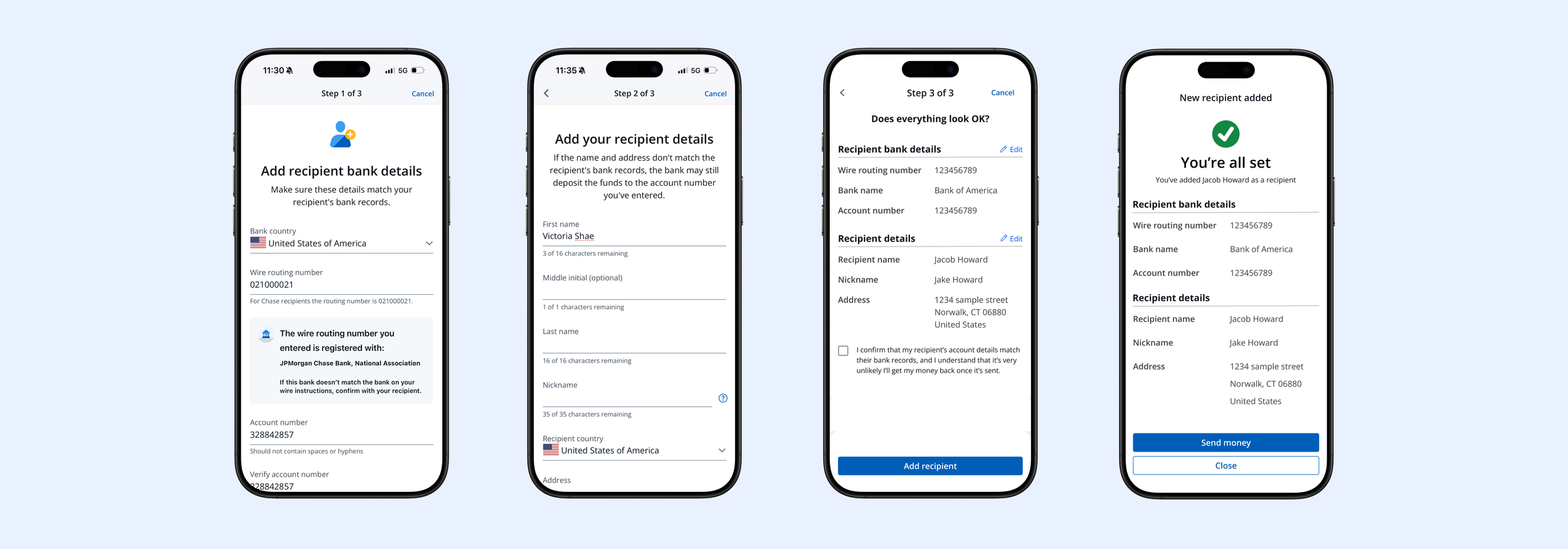
The wires team completely revamped the “Add Recipient” flow, historically the biggest drop-off point, evidenced by low completion rates and high complaint volumes. In a project aimed at reducing friction and increasing transparency, we redesigned the experience end to end across desktop, mobile, international and domestic.
Scope
Desktop & mobile
International & domestic
Business & consume
Our team
1 design lead
1content designer
1 researcher
2 product managers
4 developers
The biggest hurdle in the wires flow
Only 63% of customers were completing add recipient. When compared to five other payments products at Chase, wires has the lowest submission rates and the highest click count and time to send. The Digital Operations Insights Team listened to 275 calls and found a common thread of anxiety, specifically the fear of misrouting money to the wrong account.
Three main friction points
Call analysis across 275 sessions surfaced a common thread of anxiety and fear of misrouting. We mapped that anxiety to three concrete failure points in the flow.
Bank address mismatch: Bank address database sorting entries alphabetically. Customers might see an address for their recipient's bank in a completely different state — leading to confusion and a surge in branch complaint calls.
Name length workaround: Customers whose names exceed 35 characters were directed to type what fits in the "Recipient name" field and write the full name in "Message to recipient" — a hidden workaround causing ADA failures and errors.
Never-ending process: VOC analysis surfaced the pain point of users having no mental model of how long the process takes. Fields keep appearing with no sense of progress or end.
How we fixed each one
Each friction point had a targeted solution:
Removing the bank address: Customer interviews surfaced that recipients rarely provided bank addresses, and customers often google for the SWIFT code anyway. We removed the field entirely — as customers enter their routing number, the bank name populates automatically.
Informing with an error state: We implemented a native character counter that informs the customer we can only include the first 35 characters of the recipient's name. Clear, upfront, no hidden workarounds.
Breaking the flow into 3 steps: A step-by-step approach gives customers a clear mental model of progress. Step 1 of 3: bank details. Step 2 of 3: recipient details. Step 3 of 3: review.
Next steps & retro
A step further: We delivered strong improvements, however, this feels like just the beginning. The design has the potential to become more competitive with fintechs using new wires technology.
Evolving project management: This extended project saw transitions in product managers and design leads. I adapted by strengthening project management practices, particularly learning to document everything in a changes log.
Looking forward: 'Add recipient' was the first large E2E project in a decade on the wires team. There are a lot of areas within wires that would benefit from an overhaul and bringing this ‘step by step’ thing a lot farther with content strategy.